
Clocks go back or forward: a toddler sleep plan
Twice a year the clocks move by an hour and a toddler’s body clock stays exactly where it was. When the clocks go back in autumn, a child who woke at six now wakes at five. When they go forward in spring, bedtime arrives an hour before they are tired. Neither lasts, and a little preparation in the week before can soften it.
When the clocks change
In the UK the clocks go forward one hour at 1am on the last Sunday in March, and back one hour at 2am on the last Sunday in October. In 2027 that is Sunday 28 March and Sunday 31 October. Source: When do the clocks change?, GOV.UK (https://www.gov.uk/when-do-the-clocks-change).
When the clocks go back
This is the one parents dread, because it turns an early riser into a very early riser. On the Sunday morning, six o’clock on your child’s body clock is five o’clock on the wall.
The gradual way. In the week before, move the whole day later in small steps. The Sleep Charity’s advice for children is to “start by moving their bedtime 10-15 minutes later every few nights”; a sleep therapist at an NHS trust suggests fifteen minutes a day. Sources: Get ready for Snoozy Sunday, The Sleep Charity (https://thesleepcharity.org.uk/get-ready-for-snoozy-sunday/); Spring forward, The Sleep Charity (https://thesleepcharity.org.uk/spring-forward-how-to-protect-your-sleep-when-the-clocks-go-forward/); NSFT sleep expert shares top tips as the clocks go back, Norfolk and Suffolk NHS Foundation Trust (https://www.nsft.nhs.uk/news/nsft-sleep-expert-shares-top-tips-to-help-children-sleep-better-as-the-clocks-go-back-4775).
Here is one way to do it, for a child who goes to bed at seven and gets up at six:
| Evening | Bedtime | Wake time to set for the next morning |
|---|---|---|
| Monday | 7:10 pm | 6:10 am |
| Tuesday | 7:20 pm | 6:20 am |
| Wednesday | 7:30 pm | 6:30 am |
| Thursday | 7:40 pm | 6:40 am |
| Friday | 7:50 pm | 6:50 am |
| Saturday, the night the clocks go back | 8:00 pm | 6:00 am on the new time, which is 7:00 by the old |
| Sunday | 7:00 pm | 6:00 am |
Move naps and meals by the same ten minutes each day, so the whole day shifts and not only the end of it. By Sunday morning the clocks have gone back, and the day you have built lands on the usual times. Ten minutes every night is quicker than The Sleep Charity’s every few nights: slow it down, and start earlier, if your child needs it.
The other way. Do nothing beforehand, keep to the new clock time from the Sunday, and expect a few early mornings while their body catches up. Treat the early wakings as night: low voice, no lights, back to bed. Give it a week or so.
Both are used. Choose by how your child takes to change.
When the clocks go forward
In spring the problem moves to the evening. Seven o’clock on the wall is six o’clock on their body clock, and they are not tired. The mornings may get easier for a while.
- In the week before, move bedtime ten minutes earlier each night, and the naps, meals and wake time with it. The Sleep Charity’s advice for spring is 10 to 15 minutes earlier each day for a few days before the change.
- Make the bedroom dark: the evenings are light from now until autumn.
- Keep the routine the same, in the same order, at its new time.
The same child, bed at seven and up at six, in the week before the clocks go forward:
| Evening | Bedtime | Wake time to set for the next morning |
|---|---|---|
| Monday | 6:50 pm | 5:50 am |
| Tuesday | 6:40 pm | 5:40 am |
| Wednesday | 6:30 pm | 5:30 am |
| Thursday | 6:20 pm | 5:20 am |
| Friday | 6:10 pm | 5:10 am |
| Saturday, the night the clocks go forward | 6:00 pm | 6:00 am on the new time, which is 5:00 by the old |
| Sunday | 7:00 pm | 6:00 am |
Waking a child earlier each day is the hard part of this one. If you would rather not, move only the bedtime and let the mornings follow.
What to do with a sleep clock
A sleep clock earns its place in these weeks, because it gives your child something to check other than the light outside the window. Move its wake time in the same small steps as bedtime, and tell your child nothing has changed: stars mean sleep time, the sun means get up.
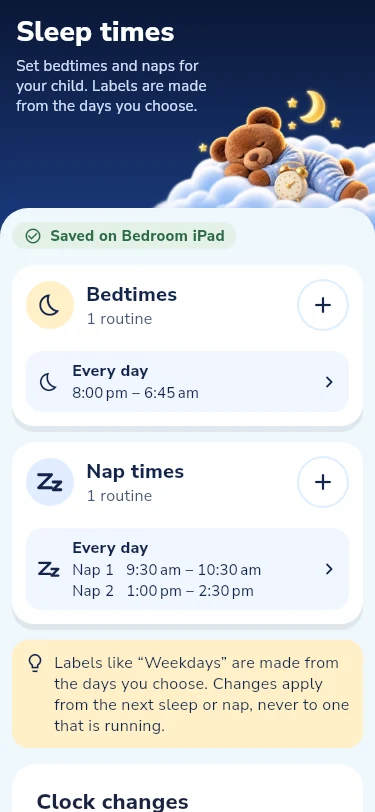
With Snoozaroo you change the times from your phone, so there is nothing to reprogramme in the bedroom. Snoozaroo keeps the times you set in your home time zone and handles the hour’s change itself: after the clocks move, seven o’clock is still seven o’clock. For one odd night, a one-off change on the Sleep times page sets different times for tonight only and leaves the usual times alone.
A clock that does not set itself has to be changed by hand. If yours is a Groclock, the Gro Clock instructions cover how to set the time.
If early waking stays
If your child is still waking an hour early a fortnight after the clocks go back, look beyond the clock change. Why is my toddler waking at 5am? goes through the usual causes and what helps.
Questions
Should I change my toddler’s sleep clock when the clocks change?
If the clock sets itself, as an app does, leave it: the wake time you chose is still right after the change. If it does not, as with a Groclock, set its time of day forward or back by an hour on the night. Either way, change the wake time only if you are moving your child’s day gradually in the week before.
What time should bedtime be when the clocks go back?
The usual time on the new clock. Their body will think it is an hour later, so expect tiredness before bedtime for a few days, unless you moved the day gradually beforehand.
Do I have to change the times in Snoozaroo when the clocks change?
No. The times you set stay the same on the clock, before and after. You only change them if you are moving bedtime gradually in the week before.
How long does a toddler take to adjust to the clock change?
It varies from child to child. Give it a week or so before you judge it; we cannot promise a number.
What about naps?
Move them with the rest of the day, by the same ten minutes. In Snoozaroo each nap has its own time, stars and wake.