Quiet time clock and nap clock for toddlers
A quiet time clock, or a toddler nap clock, is a sleep clock used in the day. It shows a child that it is still rest time, and then that rest time is over, without you standing at the door. While they still nap, it marks the end of the nap. When the nap has gone, the same clock runs quiet time: a quiet spell with a book, and a clear end to it.
What a quiet time clock does
- For a nap, the clock answers the question a toddler asks by getting up: is it time yet? While the stars are out it is still nap time. When the sun comes up, the nap is over.
- For quiet time, nobody has to sleep. The rule is only that they rest quietly, where you have agreed, until the clock says so. The clock makes the end of quiet time something they can see, so they are not calling out to ask.
It is the same signal as at night, which is the point: a child who knows that stars mean sleep time and the sun means get up does not have to learn anything new for the daytime.
How much day sleep a toddler needs
NHS guidance for parents says toddlers and preschoolers need 10 to 14 hours of sleep every day, and asks parents to be consistent with bedtimes and naptime. Source: Sleep routines for toddlers and children, Cambridgeshire and Peterborough NHS (https://cambspborochildrenshealth.nhs.uk/sleep/healthy-sleep-routines/sleep-routines-for-toddlers-and-children/).
How that splits between night and day changes with age. An NHS leaflet for parents of one to two year olds puts it this way: “At around 18 months your toddler’s time spent napping may reduce, and most children stop napping between age 3-4 years, but every child is different.” Source: Your toddler’s sleep at 1-2 years, Wirral Community Health and Care NHS Foundation Trust (https://www.wchc.nhs.uk/wp-content/uploads/2019/12/SaferSleep_1-2years.pdf). If you are unsure whether your child still needs a nap, your health visitor can help.
Setting up a nap clock
- Pick one time and keep it. A nap that starts at the same time each day is easier to settle into than one that moves.
- Use a short version of bedtime. Tidy up, a book, lie down. The same NHS page says a naptime routine should be a shorter version of the bedtime one.
- Set the end, not only the start. The NHS page suggests keeping naps before 3pm. Set the wake time so there is a clear gap before the evening.
- Use the same words as at night. “Stars mean rest time. When the sun comes up, you can get up.”
- Make the room dim. It does not need to be dark, but a darker room helps a child who is trying to switch off in daylight.
Quiet time when the nap has gone
Some families keep a quiet rest in the middle of the day after the nap has gone. It is a choice, not a rule. If you do, agree what quiet time means: where they rest, what they may have with them, and no calling out unless something is wrong. The NHS page above suggests that a child who only needs to sit and rest does it somewhere other than their own bed, such as a comfy chair, so the tablet can go wherever that is. Start with a length they can manage and build up from there. The clock is the part that keeps it fair: you are not the one deciding when it ends.
How Snoozaroo runs naps
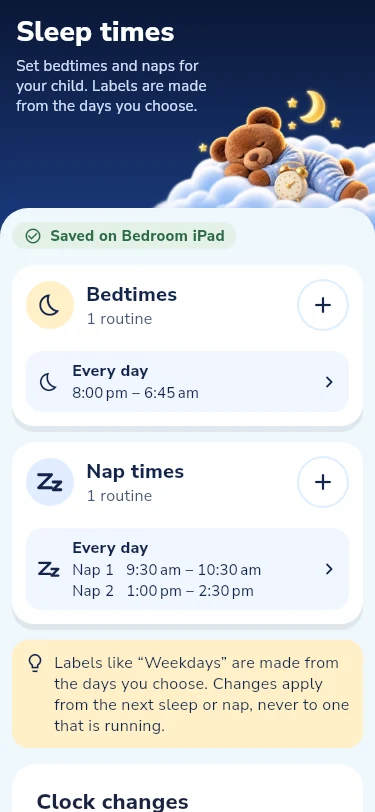
- Naps are part of the free clock. You add naps on the Sleep times page for the days you choose, each with its own start and wake time.
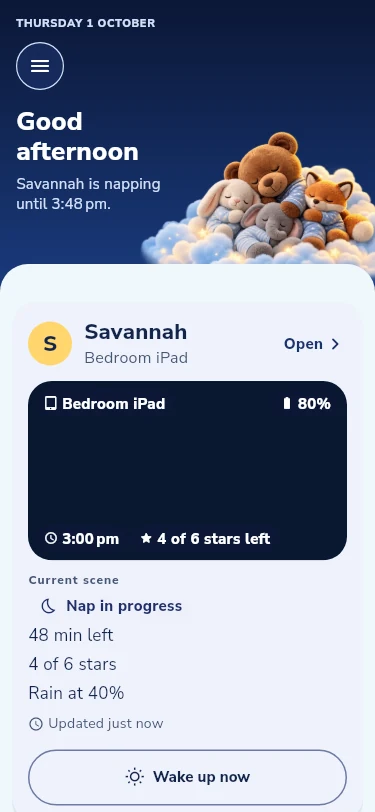
- Each nap has its own stars and its own sunrise. The pal settles, six stars glow and go out one by one through the nap, and the sun comes up when it is over.
- Each nap can have its own sound, and its own time for the sound to stop.
- With Plus, balloons can follow a nap. Turn on Balloons after naps, or keep the surprise for the mornings.
- With Plus, you can start a nap from your phone, or end one, while the app is open on the screen. A nap can also have its own short routine. See the bedtime routine app.
Set it up once in Parent mode and the bedroom screen does the same thing every day. How the sleep clock app works has the whole picture.
Questions
What is a quiet time clock?
A clock that shows a child when quiet time is over. It is a sleep trainer clock used in the day, with the wake time set to the end of quiet time.
Can I use one clock for night and for naps?
Yes. In Snoozaroo the night and every nap are on the same Sleep times page, and the screen shows the same stars and the same sun for each.
My toddler has two naps a day. Does that work?
Yes. Add each nap for the days it happens. Each one has its own stars and its own wake time.
Can I end a nap early without going in?
With Plus, yes: start the wake from your phone, while the app is open on the screen. Without Plus, change it on the tablet itself, behind the grown-up PIN.
Is quiet time screen time?
The screen is on, but there is nothing to watch. During a nap or quiet time it shows the same dim, still scene as at night: the pal asleep and the stars. Nothing on it responds to a tap except the grown-up padlock and a small information panel. See screens and sleep.
What if they do not sleep?
Then it was quiet time. The clock’s job is the end time, not the sleep. Snoozaroo does not promise that a child will nap.
Do I need Plus for naps?
No. Naps, their stars and the basic sounds are in the free plan. See plans and prices.