
Toddler sleep regression at 2 and 3 years
A toddler sleep regression is a spell when a child who was sleeping well stops. They fight bedtime, wake in the night, get up at five or refuse the nap. Parents name these spells by age: the 18 month sleep regression, the 2 year sleep regression, and another at two and a half or three. It is not an illness. This page says what the sources describe at each age, how long it tends to last and what helps.
What a sleep regression is
“Sleep regression” is parents' word, not a diagnosis, and the NHS page on sleep and young children does not use it. Sleep Scotland’s leaflet on toddler sleep has a short section called “Regression and progression”: “Sleep changes throughout early childhood, in line with development, growth and learning. Many children experience periods of sleeping less well as they become more aware of the world around them and their ability to make choices. It is a normal part of them growing up and it will pass.” Source: Toddler sleep, Sleep Scotland, hosted by NHS Lothian (https://services.nhslothian.scot/wp-content/uploads/sites/27/2023/10/Toddler-Sleep.pdf).
The same leaflet says to parents: “you haven’t done anything wrong and neither have they. They have just grown and developed, and sleep changes are a part of that.”
Sleep regression ages: 18 months, 2 years and 3 years
The ages are parents' labels, not dates. The 2 year old sleep regression is whatever unsettles sleep at around two, and many toddlers have no regression at all.
| The age parents name | What the sources describe |
|---|---|
| About 18 months | More independence and resistance at bedtime, and separation anxiety (the Sleep Foundation). A “strong opinion” about the nap (Sleep Scotland) |
| About 2 years | A toddler “learning the power of no”, with a “profound need for connection”; the move from a cot to a bed, which many families make from around 18 months; toilet training; a new sibling (Sleep Scotland) |
| 2.5 to 3 years | None of the sources below describes this one separately. The nap is changing: “most children stop napping between age 3-4 years, but every child is different” (an NHS leaflet) |
Parents also talk about a 2.5 year sleep regression and a 3 year old sleep regression. The advice below is the same at each age. The nap quotation is from Your toddler’s sleep at 1-2 years, Wirral Community Health and Care NHS Foundation Trust (https://www.wchc.nhs.uk/wp-content/uploads/2019/12/SaferSleep_1-2years.pdf).
A sleep clock is for children from about two: see where a sleep clock fits.
How long does a sleep regression last?
There is no official figure, because it is not an official condition. The Sleep Foundation, a US sleep information site, says the signs of an 18-month sleep regression rarely last more than a few weeks, and that many toddlers do not have one at all. Source: 18-month sleep regression, Sleep Foundation (https://www.sleepfoundation.org/baby-sleep/18-month-sleep-regression), read on 12 November 2026. We have found no figure from a health body for a sleep regression at 2 years or later. Sleep Scotland says only that “it will pass”.
What helps
The NHS has no page on regressions. Its advice on sleep for young children is short, and it is about settling a child at any time. Source: Sleep and young children, NHS (https://www.nhs.uk/conditions/baby/health/sleep-problems-in-young-children/).
- Keep bedtime the same. The NHS: “Make sure you have a calming, predictable bedtime routine that happens at the same time and includes the same things every night.”
- Take them back, quietly. The NHS: “If your child gets up, keep taking them back to bed again with as little fuss as possible.” It adds: “Try to be consistent. You may have to repeat this routine for several nights.” The steps are in what to do when a toddler won’t stay in bed.
- Be boring at night. The NHS: “If your child wakes up during the night, be as boring as possible to avoid exciting them and leave lights off.”
- Look at the nap. The NHS says to avoid long naps in the afternoon. Sleep Scotland suggests that if your toddler is very wakeful at bedtime, you try moving the nap earlier and making it shorter.
- Give them more of you in the day. Sleep Scotland: “A child who wakes through the night looking to socialise may benefit from more chance to connect with you during the day.”
- Do not rush the move to a bed. Sleep Scotland: “if your child is fine in their cot, there is no need to rush to the big bed.” It adds: “If you can, avoid moving a toddler out of their cot for a new baby.”
- Take a new fear seriously. The NHS: “If your child is afraid of the dark, consider using a nightlight or leaving a landing light on.”
Sleep Scotland gives the recommendation for toddlers as 10 to 14 hours of sleep, daytime naps included, and adds that every child is different. If yours takes a long time to settle, it suggests trying a bedtime half an hour later.
Where a sleep clock fits
Part of a regression is a child finding out that they have a say. A sleep clock does not argue with them. It gives the rule a picture: it is night, or it is morning, and the picture is the same whoever puts them to bed.
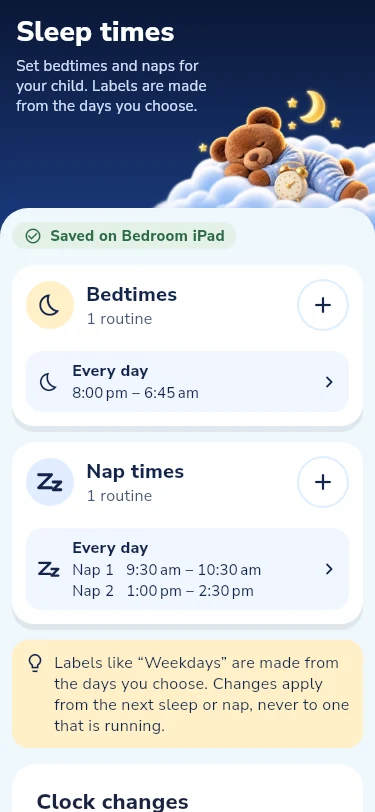
That is what Snoozaroo is: a sleep clock as an app on an Android tablet or phone. Your child’s pal goes to sleep under six stars. The stars go out one by one through the night, and the sun comes up at the wake time you set, from your own phone. A child who wakes at five does not have to come and ask whether it is morning. The answer is in the room.
How much a child can do with that depends on their age:
- At 18 months it is a bedtime cue and no more. The pal is asleep, so it is sleep time.
- From about two is the age we give for Snoozaroo, with most children understanding it by three. A two-year-old can see that the stars mean night and the sun means morning. Waiting for the sun takes practice, so start with a wake time close to when they wake now.
What matters more than the birthday is whether your child can follow a simple “when this, then that” rule in the day.
With Plus, the pal can also lead a bedtime routine of the steps you choose, in the same order each night. It puts a screen in the routine, which is a fair thing to weigh.
Snoozaroo does not end a sleep regression, and it does not promise a change in sleep. It keeps one thing the same while other things are changing.


When to ask for help
The NHS: “Talk to your health visitor if you need further advice.” You do not need to wait. If your child snores, seems to pause in their breathing or is exhausted in the day, talk to your GP or health visitor. The Sleep Foundation suggests raising sleep problems with a doctor if they have gone on for a month or more. A sleep clock is not a treatment.
Questions
Is this the same as a baby’s sleep regression?
The phrase is used for babies as well, most often at four months. This page is about toddlers. Snoozaroo is not for babies: a baby cannot read a signal.
Is the 2 year sleep regression real?
The poor sleep is real. The name is a label for it, not a medical term. Sleep Scotland describes a toddler as discovering and pushing boundaries, with a new bed, toilet training or a new sibling often arriving at about the same time.
Is there a 3 year sleep regression?
Many parents see one. None of the sources on this page describes it separately, and the advice is the same at three.
Does every toddler have one?
No. The Sleep Foundation says many toddlers have no sleep regression at 18 months.
Can a sleep clock help with a sleep regression?
It does one thing: it shows a child whether it is night or morning. That is some use to a child who gets up because they do not know, or who is testing the rule. It does nothing for teeth, a cold or a nap that is too late.
Should I move my toddler to a bed during a regression?
Not because of it. Sleep Scotland’s leaflet says there is no need to rush if your child is fine in the cot, and that a familiar, secure sleep space “can be very reassuring during this time of change and development”.
Is a screen at bedtime the wrong thing?
That is a fair thing to weigh. The NHS says no laptops, tablets or phones in the 30 to 60 minutes before bed. Snoozaroo’s night scene is dark, still and as dim as you set it, and nothing on it responds to a tap except the grown-up padlock and a small information panel. Keep the tablet across the room. We do not claim it is as good as no screen. See screens and sleep.